 English


Details description |
|---|
|
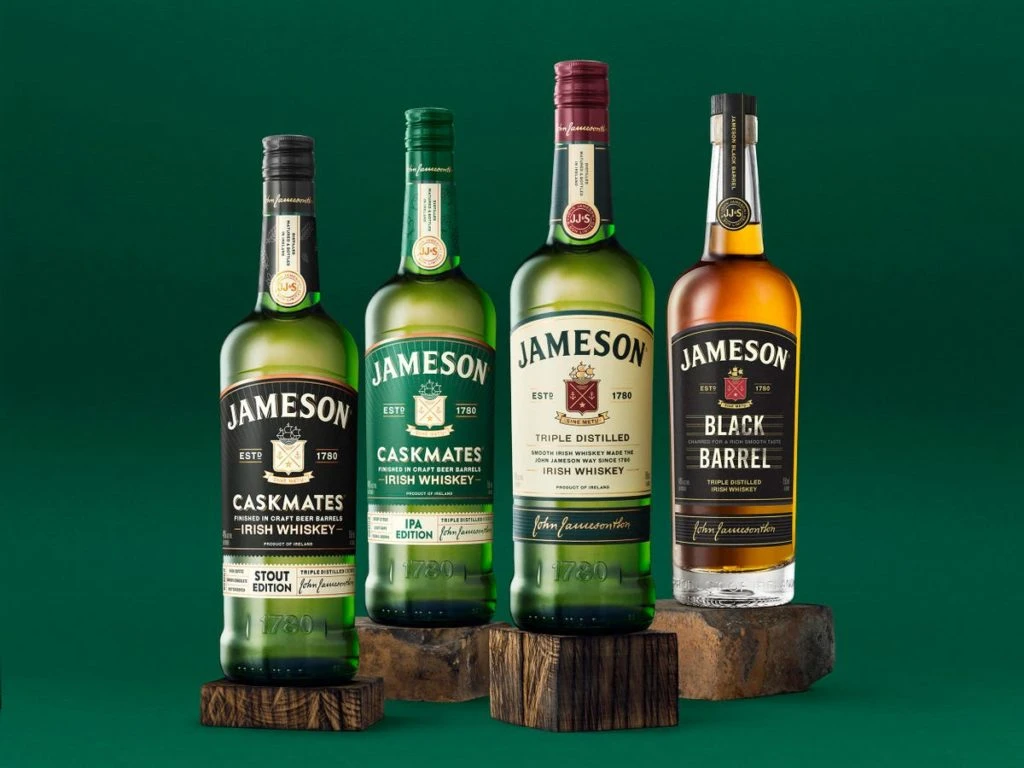
John Jameson (1740–1823) was originally a lawyer from Alloa in Scotland before he founded his eponymous distillery in Dublin in 1780.[3] Previous to founding the distillery, he married Margaret Haig (1753–1815) in 1768. She was the eldest daughter of John Haig, a whisky distiller in Scotland. John and Margaret had a family of 16 children, eight sons and eight daughters. Portraits of the couple by Sir Henry Raeburn are on display in the National Gallery of Ireland.[4] John Jameson joined the Convivial Lodge No. 202, of the Dublin Freemasons on 24 June 1774[5] and in 1780, Irish whiskey distillation began at Bow Street. In 1805, he was joined by his son John Jameson II who took over the family business that year,[6] and for the next 41 years, John Jameson II built up the business before handing over to his son John Jameson the 3rd in 1851. In 1901, the Company was formally incorporated as John Jameson and Son Ltd. Four of John Jameson's sons followed his footsteps in distilling in Ireland, John Jameson II (1773–1851) at Bow Street, William and James Jameson at Marrowbone Lane in Dublin (where they partnered their Stein relations, calling their business Jameson and Stein, before settling on William Jameson & Co.).[6] The fourth of Jameson's sons, Andrew, who had a small distillery at Enniscorthy, County Wexford, was the grandfather of Guglielmo Marconi, inventor of wireless telegraphy. Marconi's mother was Annie Jameson, Andrew's daughter; her brother, James Sligo Jameson, Andrew's son, would become a celebrated naturalist and traveller in Africa, identifying the black honey-buzzard in 1877,[7] and three African bird species – Jameson's antpecker, Jameson's firefinch, and Jameson's wattle-eye – are named after him.[8] John Jameson's eldest son, Robert, took over his father's legal business in Alloa. The Jamesons became the most important distilling family in Ireland, despite the rivalry between the Bow Street and Marrowbone Lane distilleries. 19th century and turbulent times[edit]By the turn of the 19th century, it was the second-largest producer in Ireland and one of the largest in the world, producing 1,000,000 gallons annually. Dublin at the time was the centre of world whiskey production. It was the second most popular spirit in the world after rum and internationally Jameson had by 1805 become the world's number one whiskey. Today, Jameson is the world's third-largest single-distillery whiskey. Historical events, for a time, set the company back. The temperance movement in Ireland had an enormous impact domestically but the two key events that affected Jameson were the Irish War of Independence and the subsequent trade war with the British which denied Jameson the export markets of the Commonwealth, and shortly thereafter, the introduction of prohibition in the United States. While Scottish brands could still be legally shipped to Canada (from where they could be easily smuggled across the Canada–US border) Jameson was excluded from its biggest market for many years.[9] |

No review yet!